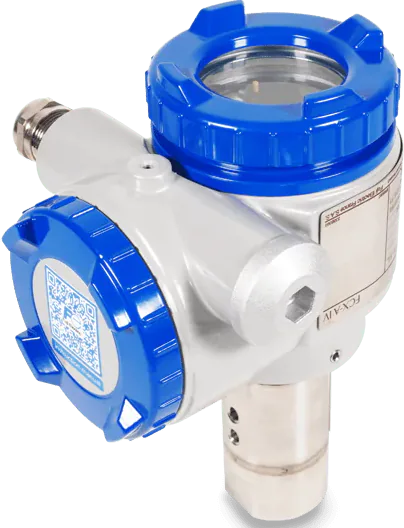
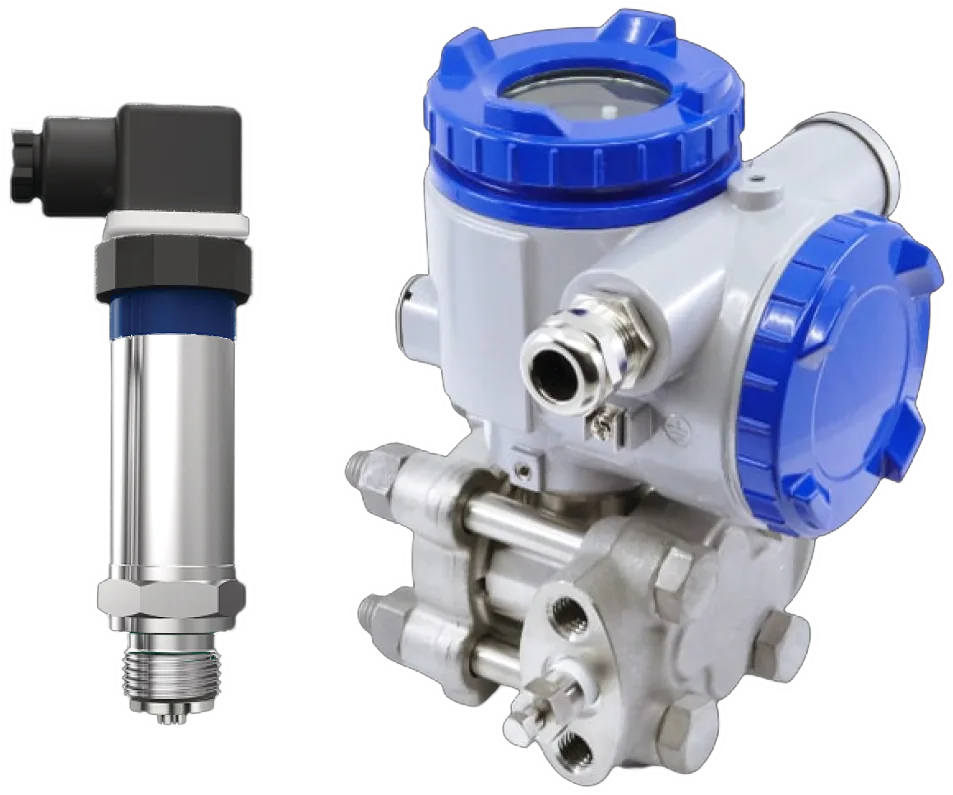
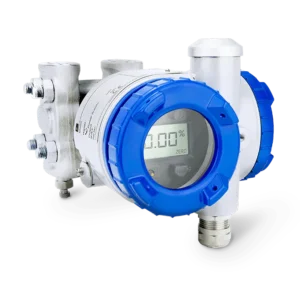
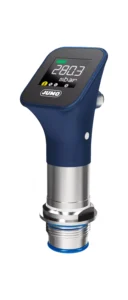
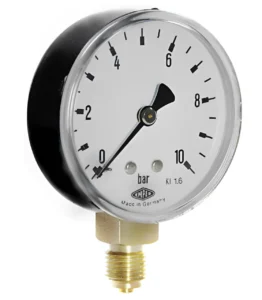
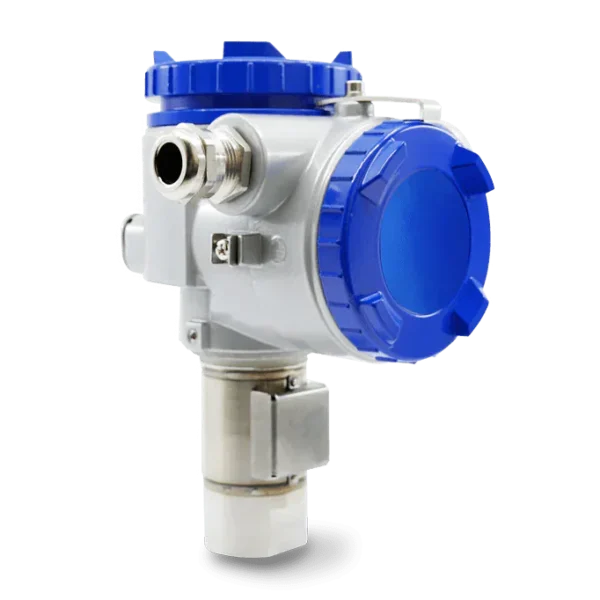
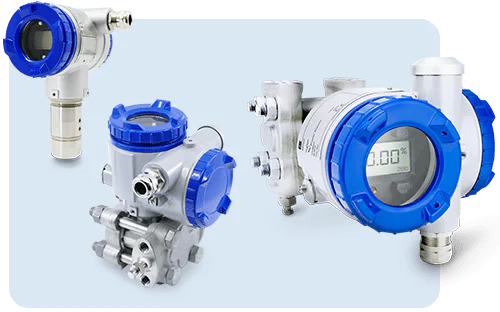
Pressure sensors are devices designed to measure pressure in gases, liquids, air, or oil. Pressure transmitters are widely used in various industrial processes, such as filtration systems, chemical feed systems, wastewater industry, food industry, pump stations, and more.
Pressure transmitters are indispensable in various industrial and technological fields.
In this guide, you will learn what a pressure transmitter is, how it works, and how pressure measurement originates—from its fundamental units to the advantages and disadvantages of different types of sensors.
We will also cover the composition of a pressure transmitter, the types of output signals, and the key criteria for selecting an industrial pressure transmitter. Additionally, we will examine different categories of pressure transmitters, including differential, absolute, and gauge pressure sensors, along with practical advice on their calibration, installation, and testing.
Finally, we will review the configuration of a pressure transmitter and its practical applications in the field, evaluating its benefits and limitations.
The Origin of Pressure Measurement
The Pascal unit of measurement is named after the famous French philosopher, physicist, and mathematician Blaise Pascal.
Born in Clermont-Ferrand, where the production unit of the French pressure transmitter manufacturer Fuji Electric France SAS is located, Pascal conducted a fundamental experiment by transporting a barometer to the summit of Puy de Dôme to demonstrate that atmospheric pressure decreases with altitude above sea level.
However, it was the Italian scientist Evangelista Torricelli who was the first to prove the pressure exerted by the mass of air on Earth and to develop the first mercury barometer.
Pressure Measurement Unit
The first factor, p, is expressed in terms of force F per unit area A:p = F / A
Understanding pressure units and their conversion is essential for correctly selecting the scale of an industrial pressure transmitter.
Pascal (Pa): The base unit of pressure in the International System of Units (SI). One pascal is equal to 1 Newton per square meter (1 Pa = 1 N/m²).
Bar (Bar): A commonly used pressure measurement unit in industry. One bar is equivalent to 100,000 Pa.
Standard Atmosphere (atm): Used to express barometric or atmospheric pressure. One atmosphere is equal to 101,325 Pa.
What is a Pressure Transmitter?
A pressure transmitter is also known as a pressure sensor, pressure gauge, or pressure transducer. There is no fundamental difference between these terms, but a distinction can be made between standard pressure transducers and smart pressure transducers.
Based on the definition of a pressure transmitter, it is a pressure sensor that operates by converting the force exerted by fluid pressure on a specific surface (deformation) into an electrical signal.
Industrial companies use pressure transmitters for:
Measuring pressure with a relative or absolute pressure transmitter.
Flow measurement using a pressure reduction device and a differential pressure transmitter.
Level measurement with a hydrostatic pressure transmitter.
Density measurement using a differential pressure transmitter.
What is the operating principle of a pressure sensor?
The pressure of the liquid, through the connection and mechanical interface – a measurement membrane made of stainless steel, ceramic, or another noble material – acts on the internal measuring component.
The electronic measuring element converts the
pressure into a raw output signal.
How Does a Pressure Transmitter Work?
The technologies, methods, approaches, and measurement principles of pressure transmitter models vary, each designed for specific needs in process automation and industrial applications.
A piezoresistive pressure sensor measures the force acting on a metallic membrane. When stress is applied to a thin film, it deforms, and the pressure change is transmitted through an incompressible fluid (oil or water). As a result, the piezoresistive silicon element (a Wheatstone bridge circuit) deforms. This element, utilizing semiconductors, acts as a variable electrical resistor that converts deformation into an ohmic value. Some of these sensors also incorporate MEMS (microelectromechanical systems), ensuring miniaturization and increased sensitivity.
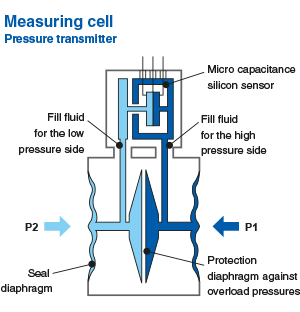
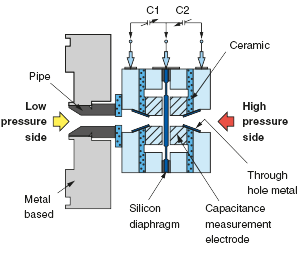
The capacitive sensor of the pressure transmitter measures the force exerted on a stainless steel or ceramic-metal diaphragm. When pressure is applied, the metal membrane deforms, transmitting the pressure change through an intermediate incompressible fluid (oil or water). This deformation affects the capacitive silicon element, which acts as a variable capacitor that converts deformation into a capacitance value.
In a frequency resonance transmitter, specific terms such as BFSL (Best Fit Straight Line) are used to define measurement linearity. This type of pressure transmitter converts pressure variations into frequency changes, offering high resolution and various solutions for different applications.
The strain gauge or tension sensor of the pressure transmitter operates similarly—the sensor's output signal is filtered, amplified, temperature-compensated, and formatted into an analog signal. The analog output is transmitted via an electrical connection, reducing errors and increasing accuracy.
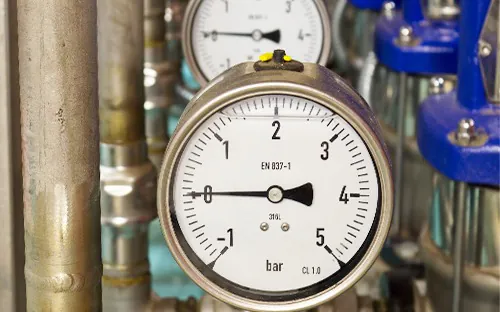
On the other hand, pressure gauges provide a local pressure measurement display. For example, U-shaped manometers are often used for simple, direct measurements.
Construction of the pressure transmitter
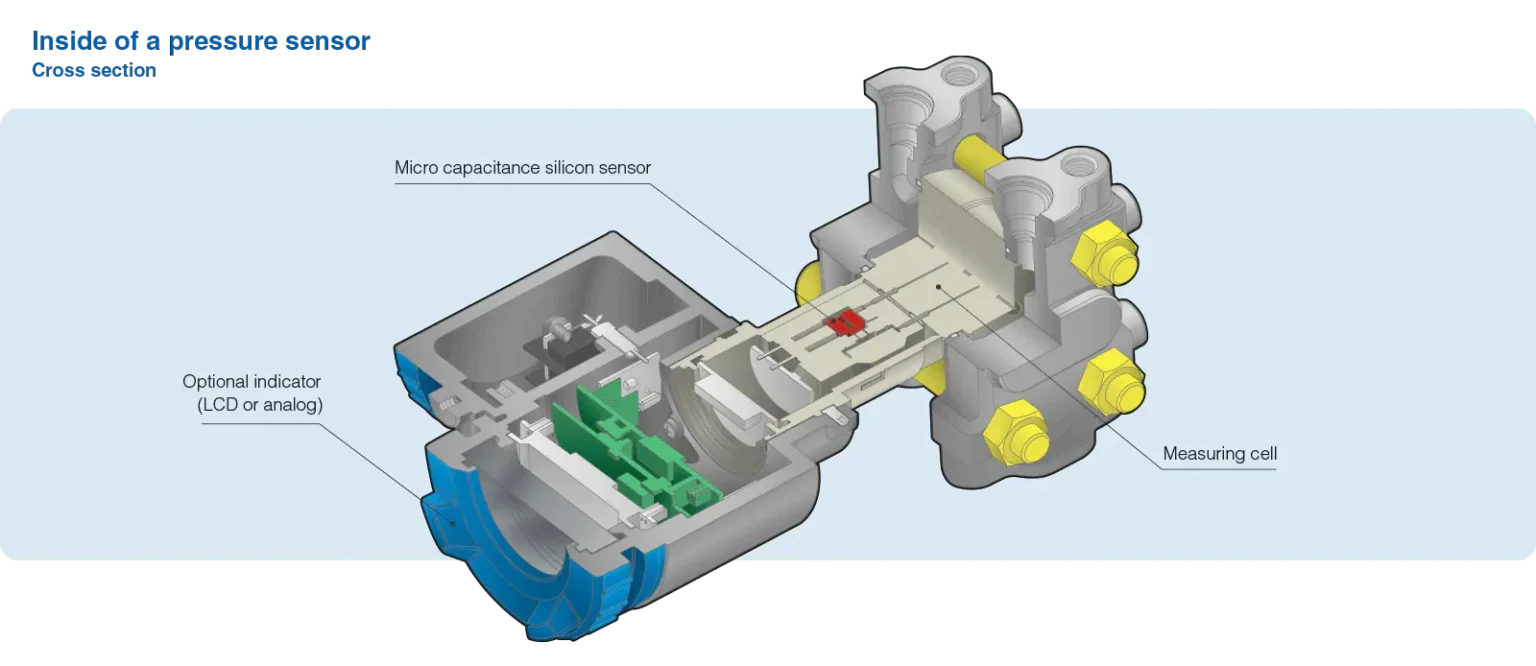
Slėgio siųstuvo konstrukciją sudaro keli esminiai elementai:
mechaninė jungtis montavimui,
metalinė arba keraminė membrana,
talpinis arba pjezorezistinis jutiklis,
užpildo skystis (dažniausiai alyva), integruotas slėgio kamerose slėgio
pokyčiams perduoti,
elektroninis modulis jutiklio signalui apdoroti ir sustiprinti,
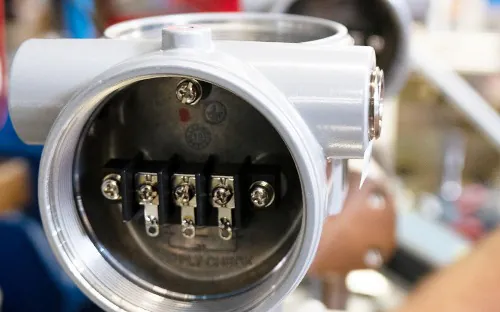
elektrinė jungtis paprastam prijungimui prie automatizavimo sistemų,
plastikinis arba metalinis korpusas (aliuminis, nerūdijantysis plienas),
skaitmeninis indikatorius (pasirinktinai) slėgio informacijai rodyti realiuoju laiku.
What is the output signal of an industrial pressure transmitter ?
Slėgio jutiklio signalas gali būti analoginis arba skaitmeninis. Analoginis signalas kinta proporcingai matuojamam slėgiui, o labiausiai paplitęs pramonėje – 4–20 mA srovės signalas, kurį lengva perduoti dideliais atstumais be tikslumo praradimo.
4–20 mA analoginis išėjimo signalas pramonėje naudojamas dažniausiai dėl kelių priežasčių:
First of all, the pressure transmitter 4-20 mA is resistant to signal loss due to the transmission line, guaranteeing accurate measurement.
It also extends the distance between pressure transmitter and the system concerned. In addition, the absence of current makes it possible to detect line faults, facilitating troubleshooting. The 4-20mA 2-wire or 4-wire pressure transmitter is also less sensitive to electromagnetic interference, which guarantees its reliability.
Finally, it can be used in a 4-20mA loop to power several devices such as the display, controller and recorder.
Skaitmeninė komunikacija galima įvairiais protokolais: HART, PROFIBUS, Modbus ir kt. Šie protokolai leidžia ne tik perduoti matavimo vertę, bet ir nuotoliniu būdu konfigūruoti prietaisą, atlikti diagnostiką ir gauti papildomų proceso duomenų – tai ypač naudinga didelėse automatizuotose sistemose.
How to choose an industrial pressure transmitter ?
The industrial pressure transmitter must be selected according to the fluid to be measured, the pressure range and the operating conditions of the application and process.
Matuojamos terpės savybės – temperatūra, klampa, agresyvumas, higienos reikalavimai lemia membranos medžiagą ir procesinę jungtį.
Matavimo tipas – santykinis, absoliutus ar diferencinis slėgis.
Matavimo diapazonas – parenkamas taip, kad darbinis slėgis būtų 25–75 % diapazono ribose.
Išėjimo signalas – 4–20 mA, įtampos išėjimas ar skaitmeninis protokolas pagal valdymo sistemą.
Aplinkos sąlygos – temperatūra, drėgmė, vibracijos, sprogi aplinka (ATEX) lemia korpuso klasę ir sertifikatus.
Invertas, UAB has become the official JUMO distributor in Lithuania – new opportunities for the country's industry. The Lithuanian industrial sector is rapidly modernizing, and the automation, measurement...
Powerful 560kW VACON 100 FLOW – now at Kauno Energija's Petrašiūnai power plant! Kauno Energija has recently installed one of the largest Danfoss VACON 100...
Accurate steam flow measurement with Orifice Plate: Invertas, UAB implemented the solution in Rietavas veterinary sanitation Invertas, UAB, an official Fuji Electric Premium partner...