Home > Temperature sensors > Signal converters
Signal converters
Temperature signal converters (head or DIN rail) to convert the sensor signal to standard 4-20 mA.

Frequency converters, Motor drives (VFD)
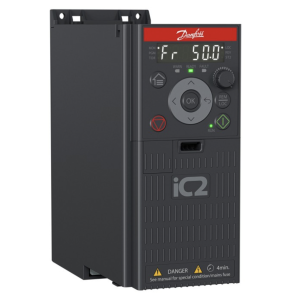
Danfoss iC2 Micro

Frequency converters, Motor drives (VFD)
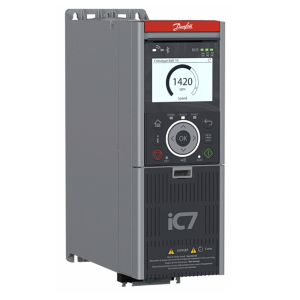
Danfoss iC7 Automation

Frequency converters, Motor drives (VFD)
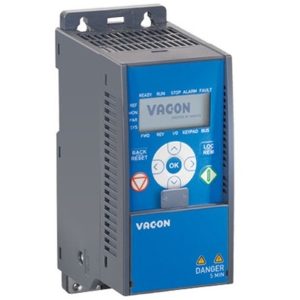
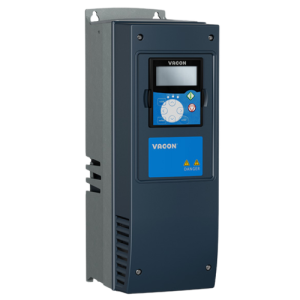
VACON 20

Frequency converters, Motor drives (VFD)
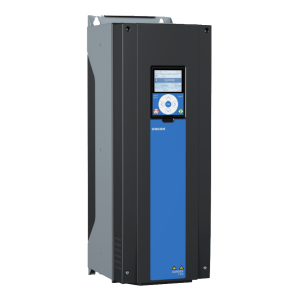
VACON 100 FLOW

Frequency converters, Motor drives (VFD)
VACON 100 INDUSTRIAL

Frequency converters, Motor drives (VFD)
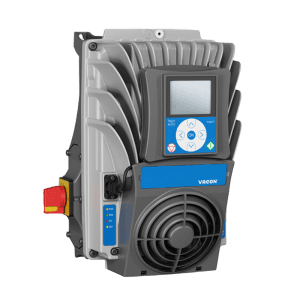
VACON 100X

Frequency converters, Motor drives (VFD)
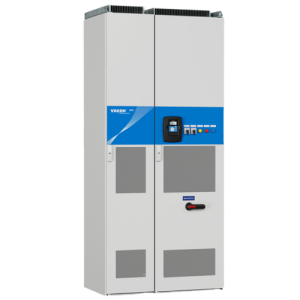
VACON NXP

Frequency converters, Motor drives (VFD)
VACON NXC

Frequency converters, Motor drives (VFD)
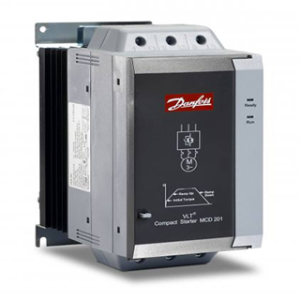
Danfoss MCD 200

Frequency converters, Motor drives (VFD)
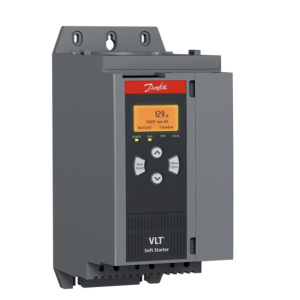
Danfoss MCD 600
The highest quality of every product
Local services near you
Customer service every step of the way
Smooth technical communication
Temperature signal converters
Temperature signal converters (also called temperature transmitters) convert signals from temperature sensors – thermocouples, resistance thermometers (RTDs) and thermistors – into standardized output signals: 4–20 mA current loop, 0–10 V voltage or digital bus (HART, Modbus, Profibus). Such conversion allows for the transmission of accurate measurements over long cables without significant signal loss or electrical noise.
Signal converters are essential in industrial process control, building automation, and laboratory systems where long cable runs or different sensor types need to be connected to the controller.
What are temperature signal transducers?
A temperature signal converter is an electronic device that receives a weak analog signal from a temperature sensor and converts it into a standardized signal suitable for transmission and further processing. The most common output signals are: 4-20 mA current loop, 0-10 V voltage, RS-485 / Modbus RTU, HART or other industrial protocols.
The transducers can be mounted on the sensor (head mounting), on a DIN rail in control panels or as separate PLC/DCS modules. Many models integrate galvanic isolation, signal filtering and cold junction compensation.
Types and applications of temperature signal transducers
- Head converters: mounted directly on the sensor in the connection head – a compact, environmentally friendly solution.
- DIN rail converters: universal, easily changed and configured in control panels.
- 4-20 mA transmitters: analog industrial standard, resistant to electrical noise, suitable for long distances.
- HART converters: compatible with analog 4-20 mA signal and digital communication channel; remote configuration and diagnostics possible.
- Modbus / Profibus converters: fully digital, integrated into SCADA and DCS systems, often multi-channel.
- Isolated transducers: galvanic isolation protects against potential differences and noise in long lines.
How to choose a temperature signal converter
When selecting a signal converter, the most important thing is to match it with the sensor used: thermocouple (K, J, T, N, S, R, B type) or resistance thermometer (Pt100, Pt1000, Ni100). Universal converters allow you to configure the input type programmatically.
Evaluate the required output signal: 4-20 mA for analog control or digital protocol (HART, Modbus) for system integration. Check compatibility with PLC or DCS system.
Pay attention to measurement accuracy (0.1–0.5 °C), galvanic isolation (important for safety and noise reduction), mounting method (head or DIN rail), supply voltage (loop powered or external power supply), and environmental conditions – permissible temperatures, humidity, and degree of protection (IP54, IP67).
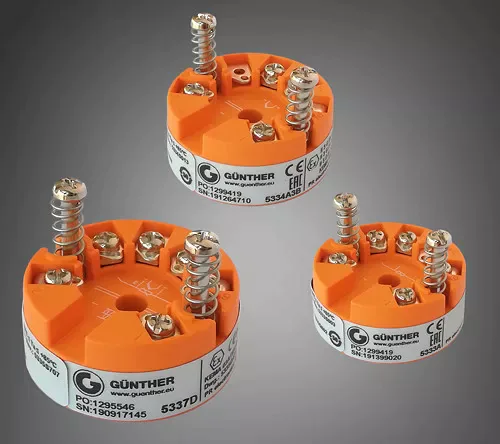
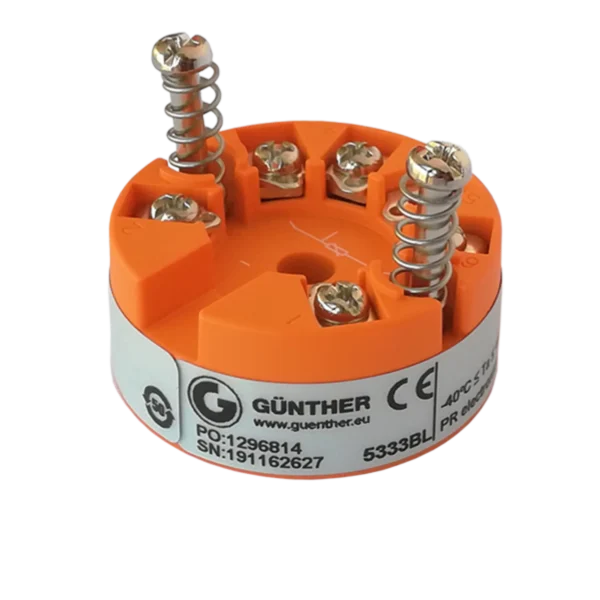
Head-mounted transmitter GT 5333BL
Temperature transmitter mounted in the head (sensor terminal head). Parameters and sensor error detection are configured by computer via special software. Accepts Pt100, Pt1000, Ni100, Ni1000 or resistance (R [Ω]) signal, 2 or 3-wire sensor connection, analog 4–20 mA output, complies with NAMUR NE 43 standard. Power supply 8…35 V DC. Certificate: CE.
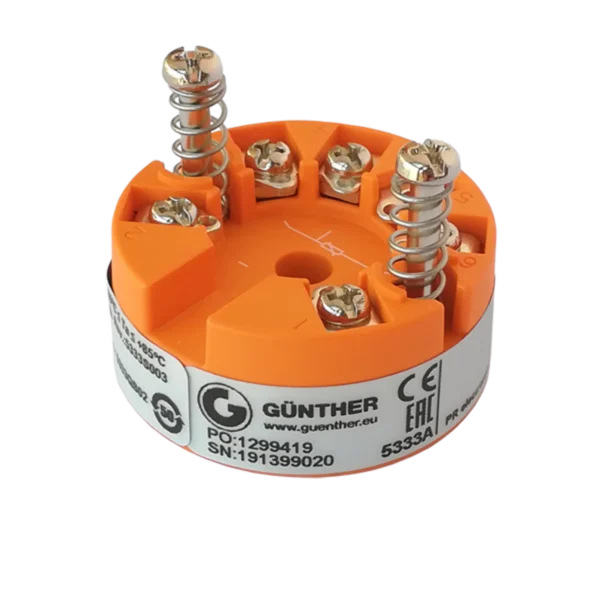
Head-mounted transmitter GT 5333A
Head-mounted temperature transmitter with one measurement input (Pt100, Pt1000, Ni100, Ni1000 or R [Ω]) and analog 4–20 mA output. 2 or 3-wire sensor connection, sensor error indication according to NAMUR NE 43, possibility of precise process calibration. Power supply 8…35 V DC. Certificates: CE, INMETRO, EAC, DNV.
Head-mounted transmitter GT 5334A3B
Head-mounted temperature transmitter with one input for thermocouples (B, E, J, K, L, N, R, S, T, U, W3, W5, LR) or mV signal and 4–20 mA output. Integrated cold junction compensation (CJC) sensor, galvanic isolation 1500 V AC, error indication according to NAMUR NE 43, precise process calibration. Parameters configurable via PC. Power supply 7.2–35 V DC. Certificates: CE, INMETRO, EAC, DNV.
FAQ about temperature signal converters
Frequently asked questions about the selection, installation and use of temperature signal transducers.
What is the difference between a head converter and a DIN rail converter?
A head converter mounts directly on the sensor, providing a compact, weatherproof solution. A DIN rail converter mounts in a panel, is easier to replace, and typically offers more configuration options and better access.
Can the converter be used with any thermocouple?
No – the transducer must be configured to work with a specific thermocouple type (e.g., type K or J). The wrong type will cause systematic measurement error.
What is galvanic isolation and when is it necessary?
Galvanic isolation electrically separates the input from the output, protecting against ground loops, high potentials and noise. It is recommended when the sensor and controller are on different grounding systems or when the distance between them is large.
How often should the transducer be calibrated?
Calibration is recommended every 1-2 years, depending on process requirements and manufacturer recommendations. Transmitters that support the HART protocol often allow for remote calibration.
RELATED ARTICLES
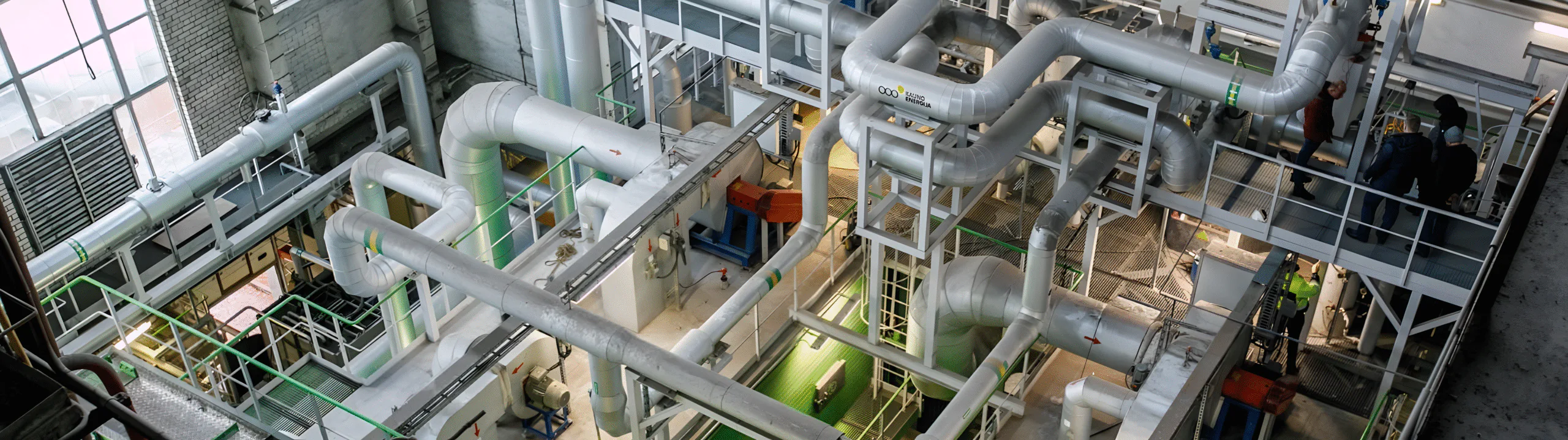
Powerful 560kW VACON 100 FLOW – already at Petrašiūnai power plant!
Powerful 560kW VACON 100 FLOW – now at Kauno Energija's Petrašiūnai power plant! Kauno Energija has recently installed one of the largest Danfoss VACON 100...
More
Accurate steam flow measurement with Orifice Plate – Biovast Lithuania
Accurate steam flow measurement with Orifice Plate: Invertas, UAB implemented the solution in Rietavas veterinary sanitation Invertas, UAB, an official Fuji Electric Premium partner...
More