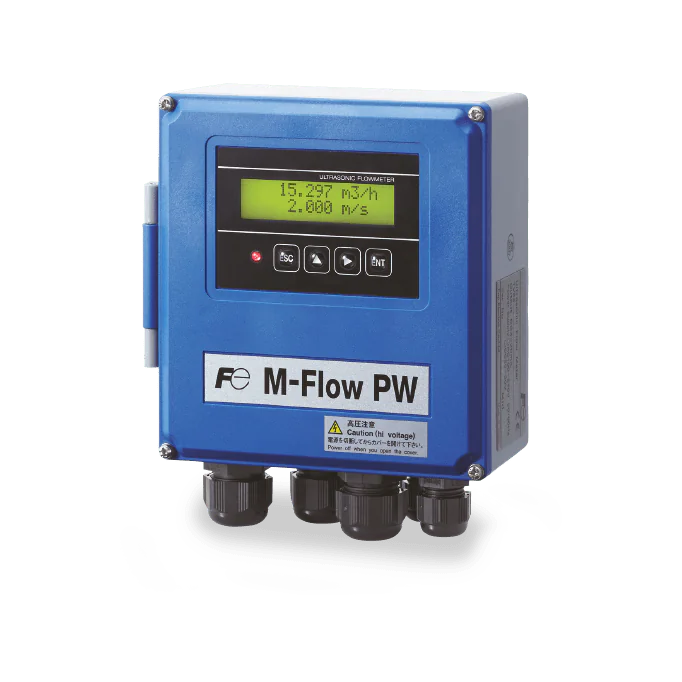
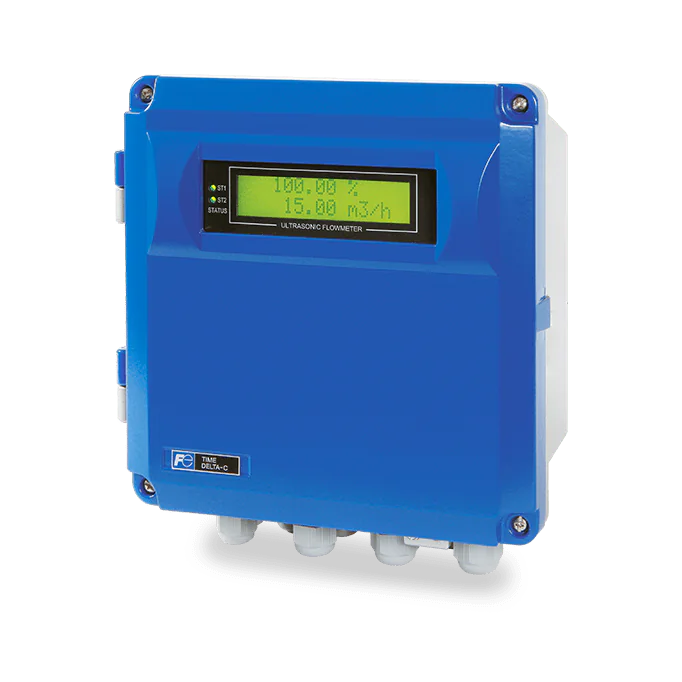
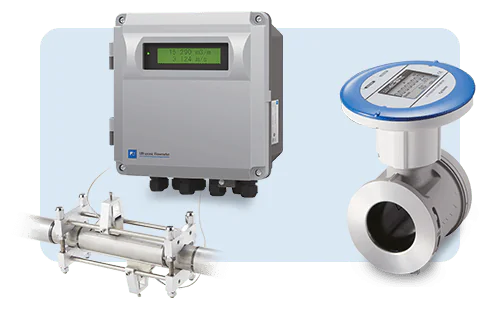
Flowmeters - precise and reliable monitoring of liquid and gas flows. Choose high-quality solutions to ensure efficient process management and performance.
How to measure the mass and volume flow rate of liquid, water, gas or steam?
Our experts explain the definition, operating principle, and introduce various types of flow meters, their installation, and maintenance.
Learn all about flow measurement
Flow meters measure the flow of liquids through pipes and are used in most industrial processes. There are several categories of flow meters.
To select the most appropriate type of flow meter for a specific application, it is important to consider the process conditions, the desired measurement range and accuracy, the fluid cleanliness requirements, and whether the meter will be used to measure liquids or gases.
What is flow meter and what is the definition of flow rate?
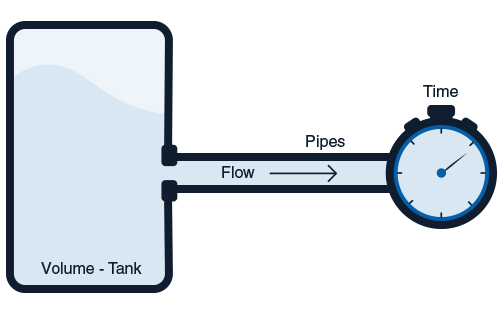
A distinction is made between volume flowmeter and the mass flow meter. A volumetric flow meter is a versatile instrument that measures the quantity of fluid (volume) passing through a given point in a given time. This device measures the volume and flow rate of the fluid flowing through a pipe, generally a liquid flow rate like water flow rate a gas flow rate and a steam flow rate.
Some measuring instruments measure mass flow, i.e. the mass of fluid flowing through a pipe over a given period of time. Conversion between volume flow and mass flow is possible when the density of the fluid is known, and other characteristics such as pressure and temperature are also known.
Note: Flow meters should not be confused with flow indicators, as the latter do not measure the flow value, but only indicate whether or not fluid is moving in the system.
What is the unit of flow measurement?
The volumetric flow rate for measuring the flow of liquids and gases, generally represented by the symbol Q, is normally expressed in m3/h or l/s.
Mass flow is expressed in grams per second (g/s) or kilograms per hour (kg/h). A common mistake when installing flow meters is to confuse common meters with flow units.
Total flow sensors measure the flow that has passed through the meter since it was first switched on.
How to choose a flow meter?
Modern flowmeters are manufactured using a wide range of technologies, exploiting a variety of physical phenomena. Their research and selection require the verification of a number of parameters.
Type of fluid
Liquid flow meter and water flow sensor, gas flow meter (e.g. air) or steam flow meter are not the same, so you need to consider what will be flowing through the pipe. The choice depends of the flow meter application and types of fluid.
Volume or mass flow meters
Flow transmitter is capable of measuring volumetric flows, but in some cases, you may wish to measure mass flows as well.
Fluid operating conditions
What is the maximum pressure of the fluid flow to be measured? What is the minimum and maximum temperature of the medium to be measured? The ability of a flow rate meter to measure temperature depends on the type of flow sensor. Some flow measurement devices are only suitable for measuring a single temperature, while others can measure a wide range of temperatures. What are the minimum and maximum flow rates you will be measuring ?
Pipe size
Pressure losses
At low flow rates, the pressure drop that occurs when installing a flow transmitter is a significant cost factor. Minimising pressure loss means minimising frictional losses in the pipework. How to choose a flow meter accuracyOne of the main objectives in designing a flow sensor is to minimise frictional pressure drop as much as possible. The pressure drop across a flow transmitter should be minimal and constant under different operating conditions.
The outside environment
Installation requirements: In general, we also need to consider the installation conditions of future flow meters.
In general, it is also necessary to assess the installation conditions of future flow sensors. When there are bends, valves, diameter changes or other irregularities in the pipeline network, medium flow disturbances occur, and some measurement technologies are sensitive to these disturbances. To avoid measurement errors due to these disturbances, it is necessary to install a sufficiently straight pipe section upstream of the flow transmitter so that the medium flow is stable. This straight section of pipe before the flow measuring devices is expressed in pipe diameter units (DN).
Other factors to consider are the accuracy and repeatability of the flow rate meter, but also the analogue or pulse output signal and the communication protocol.
Accuracy must be stable, i.e. the variation in measurement error when the operating environment changes is within a fixed range.
The flow meter must have high repeatability, i.e. the difference between two consecutive measurements must lie within a fixed range. This ensures that the meter can measure the same flow rate under different pressure conditions and with varying inlet flow rates.
The output signal is available as 4-20mA, 0-10V, 4-20mA/0-10V, pulse, digital HART, MODBUS.
How does a flowmeter work and what is its principle?
Have you ever wondered how a flow sensor works? Let's discuss the different popular flow rate measurement technologies for measuring the flow of liquids, gas and steam.
What are the different flowmeter technologies?
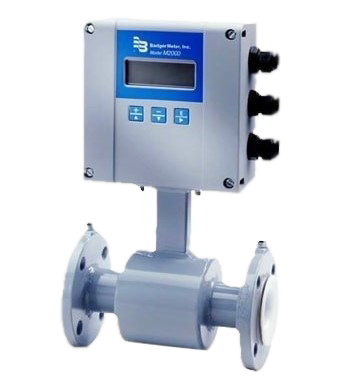
ELECTROMAGNETIC FLOWMETERS:
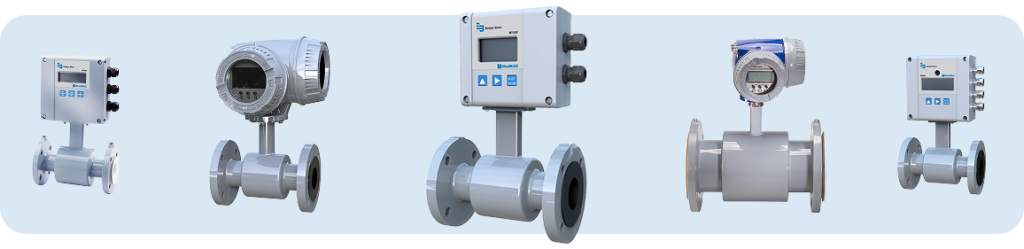
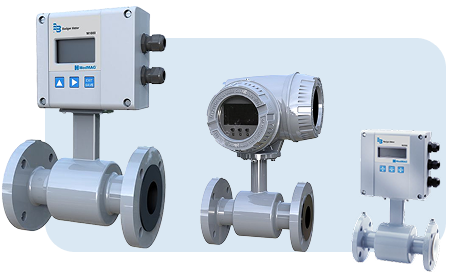
Visit electromagnetic flowmeters are composed of a transmitter and a sensor that measure the flow rate.
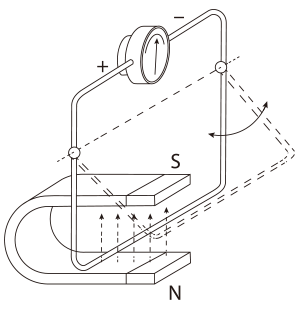
When a fluid passes through a pipe, the electromagnetic flowmeter's external sensor measures an induced voltage generated by the liquid. The transmitter measures the voltage produced by the sensor, transforming it into a flow rate value. An electromagnetic flowmeter measures flow using a pair of electrodes and a collection of coils. The electromagnetic flowmeter coils are driven by the transmitter as a result of applied currents. Once energized, a magnetic field forms between the two coils. When the pipe is filled and the fluid begins to flow, the force of the magnetic field separates the negatively and positively charged particles from the fluid.
Visit Faraday's Lawmathematically described by E = k*B*D*V, is a flow principle of magnetic flowmeters.
The induced voltage (E) is directly proportional to the velocity (V) of the fluid flowing in the magnetic field (B).
The electrode circuit transmits the induced voltage to the transmitter, which transforms the velocity into a quantitative measurement.
The volume of the fluid is estimated from this known velocity and the surface area of the pipe.
Why choose an magnetic flow meter?
Economical for liquids such as water, wastewater, aggressive chemicals and sludge
Low maintenance (not sensitive to particles, no moving parts, no clogging)
Wide range of flow meter applications (lining materials, electrode options, pipe diameters)
Bidirectional flow measurement
High measurement dynamics (measurement of very small and very large volume flows)
ULTRASONIC FLOWEMETERS:
Ultrasonic flowmeters for air
Ultrasonic steam flowmeters
Flowmeters for liquids
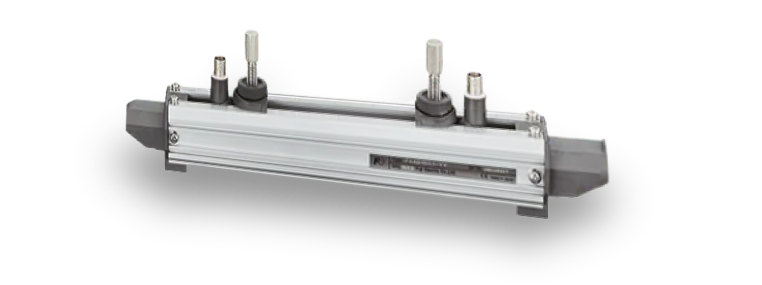
Ultrasonic flowmeters use the transit time difference or Doppler effect method. The transit time method is based on the fact that the transmission speed of an ultrasonic signal depends on the flow velocity of the medium. An ultrasonic wave moving with the flow moves faster than one moving against it. Two transducers are installed face to face on the outer wall of the pipe. The transducers each emit an ultrasonic pulse and detect the difference in pulse transit time to calculate the flow rate.
Why choose an ultrasonic flowmeter?
High measurement dynamics and turndown ratio
No process interruption during installation of the flow sensor
No direct contact with the fluid
Low installation costs
Low maintenance
Available as portable ultrasonic flowmeters and ultrasonic flowmeters for small diameters
Invertas, UAB has become the official JUMO distributor in Lithuania – new opportunities for the country's industry. The Lithuanian industrial sector is rapidly modernizing, and the automation, measurement...
Powerful 560kW VACON 100 FLOW – now at Kauno Energija's Petrašiūnai power plant! Kauno Energija has recently installed one of the largest Danfoss VACON 100...
Accurate steam flow measurement with Orifice Plate: Invertas, UAB implemented the solution in Rietavas veterinary sanitation Invertas, UAB, an official Fuji Electric Premium partner...